Dashboard
The dashboard serves as your personal workspace. You can customize it according to your needs and focus on the information that is most important for your role. With widgets, you can easily track the status of requests, access data, or quickly create new records.
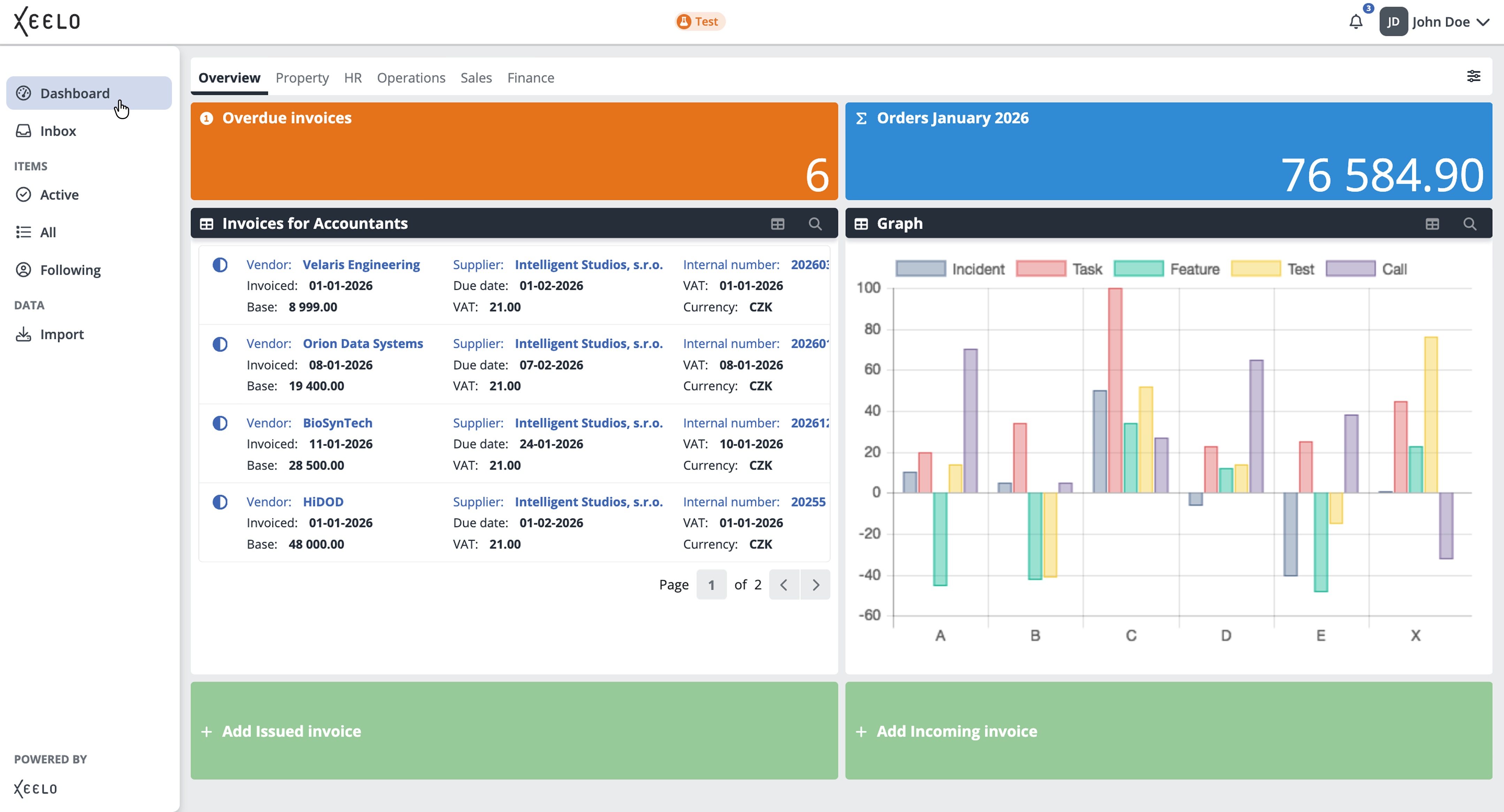
Creating a new dashboard
The dashboard is available from the side menu. If you set it as the default page in the My Profile section, it opens automatically after you sign in. You can return to it at any time by clicking the application logo in the top left corner (the Home button).
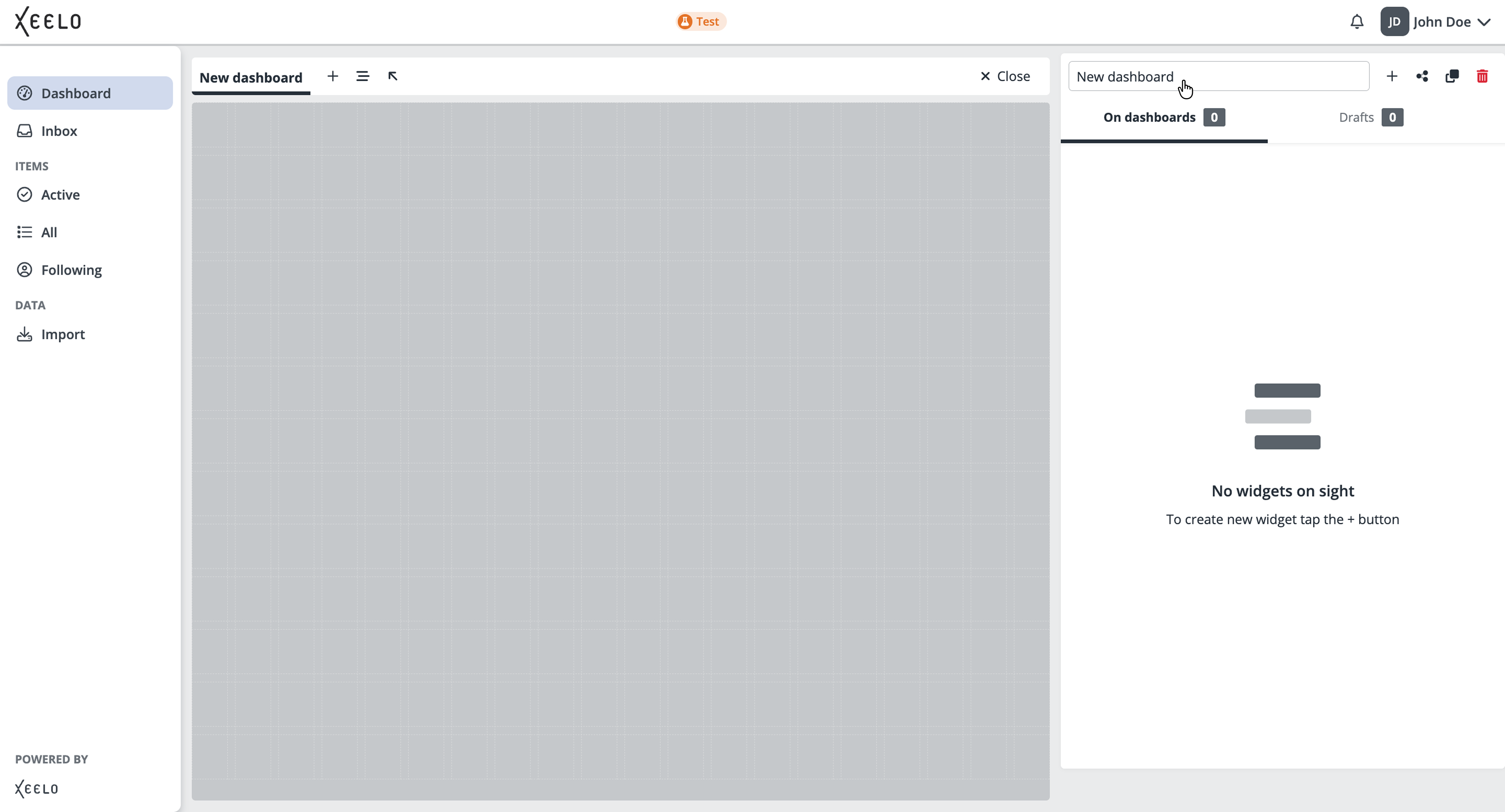
If you do not yet have any dashboard, an empty workspace with the + Create button is displayed. Clicking the button opens a new empty dashboard and splits the workspace into two main parts. The left part serves as the layout of your dashboard—this is where you place individual widgets. The right part contains the control panel, where you manage dashboard content and select widgets to use.
Each new dashboard can be named immediately. Click the field with the default name New dashboard and enter any name that describes the purpose or focus of the dashboard.
Note
You can create as many dashboards as you need—for example, based on different topics, projects, or team roles. Each dashboard is displayed as a separate tab, and their order can be easily adjusted if needed.
A dashboard can also be created using the + button in the top left corner of the screen. The menu contains two options:
-
Create new – creates a new empty dashboard.
-
Subscribe – allows you to view another user’s dashboard. This option is useful, for example, when another user has prepared a dashboard that you want to use as well, without creating your own. It is also useful when a team leader has created a unified view for the entire team.

Note
A dashboard you are subscribed to cannot be edited. You can view it, review the settings of individual widgets, and optionally copy it as your own—in that case, a new tab is created with full editing capabilities.
Dashboard management
To access dashboard management, click the Settings icon in the top right corner of the screen. If you have multiple dashboards configured, simply switch to the relevant tab and select the one you want to manage.

In the dashboard management control panel, you will find two tabs:
-
On dashboard – displays all widgets that you have already placed in the layout. It serves as a quick overview of active content.
-
Draft – contains widgets that you have prepared but have not yet published or placed on the dashboard. It allows you to work on multiple elements at the same time without affecting the existing layout.
Editing options vary depending on whether you are the owner of the dashboard or whether you are subscribed to it.

If you are the author, you have full access to dashboard management:
-
Edit name – click the text field to change the dashboard name.
-
Add new widgets – use the plus icon to add additional elements according to your needs.
-
Sharing settings – if you create a dashboard that is useful for other users, you can easily share it. The sharing icon allows you to manage access for other users.
-
Copy dashboard – create a copy of the current dashboard with all its widgets in a single click.
-
Delete dashboard – the trash icon permanently deletes the dashboard. This action is irreversible—the dashboard cannot be restored once deleted.
If you only use the dashboard but are not its author, you do not have access to editing options. In that case, you can only:
-
Remove the dashboard from your list—it will no longer be displayed.
-
Create a copy – duplicate the entire dashboard and then work with it independently, including all edits and widgets.
Automatic saving of changes
All changes you make to the dashboard (adding widgets, editing them, or removing them) are saved automatically.
When you finish your work, simply click Close. This closes edit mode and switches the dashboard back to widget view.
Widgets
Widgets are the building blocks of the dashboard. Each widget displays a specific type of information or enables a specific action. With widgets, you can customize the dashboard exactly to your needs—whether you are tracking key metrics, creating quick links to specific requests, or accessing an external application.
You can add a new widget using the + button located next to the dashboard name on the right side of the screen.

After clicking the button, a list of available widgets is displayed. Select the desired type and configure it according to your needs. The widget is automatically moved to the Draft section, from where you can add it to the dashboard.
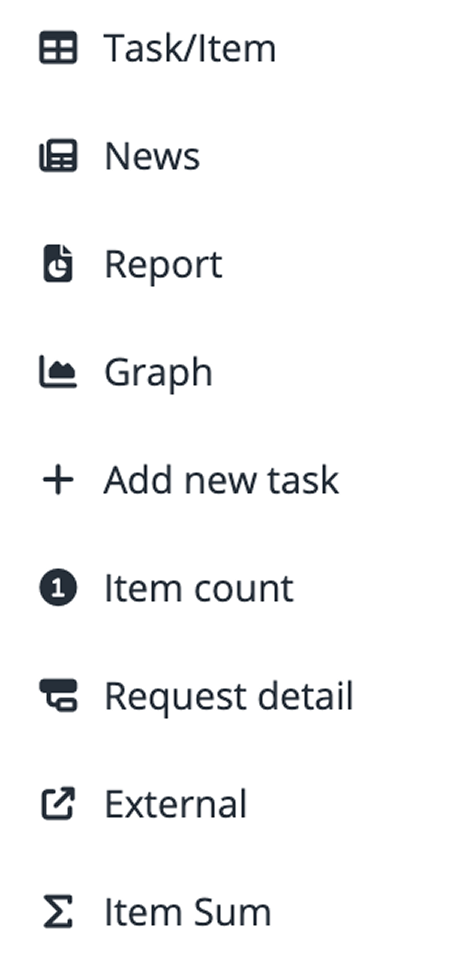
Each widget has its own specific purpose. Below is an overview of all available widgets:
-
Task / Item – Displays a list of requests based on the specified filter.
-
News – Displays internal announcements, news, or notifications.
-
Report – Displays the output of a preconfigured report.
-
Graph – Visualizes data in the form of a chart—for example, value trends.
-
Add new task – Create a new request with a single click.
-
Item count – Displays the number of requests that meet the defined conditions.
-
Request detail – Allows you to pin the detail of a specific request to the dashboard for quick access.
-
External – Displays content from an external system or website.
-
Item sum – Displays the sum of numeric values from a selected field.
Add a widget to the dashboard
Once a widget is fully configured, you can easily place it on the dashboard workspace. Grab the widget by the six dot icon located in its top left corner. Then move it to the left part of the screen, which represents the dashboard layout.
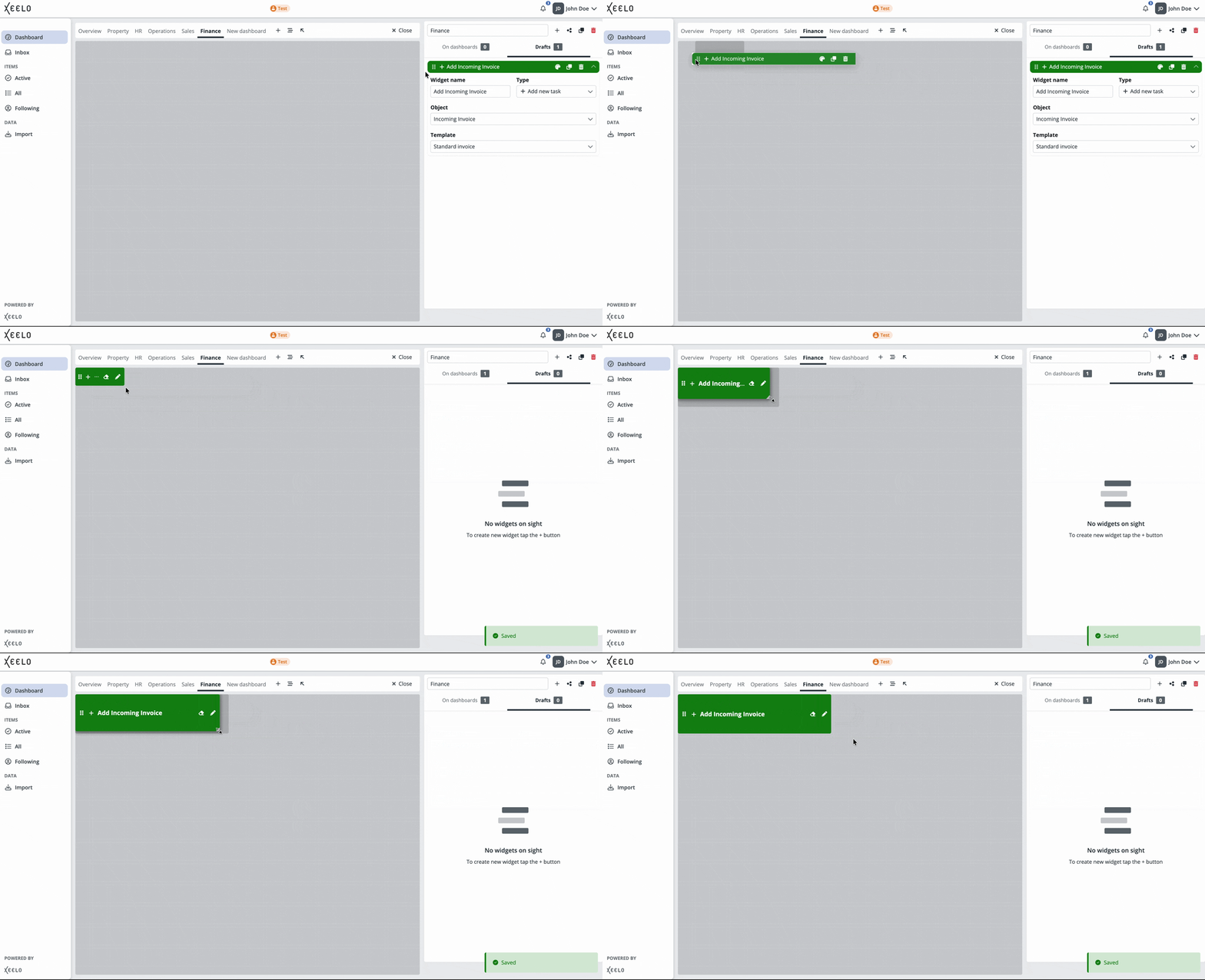
During placement, a widget preview is displayed immediately, making it easy to fine tune its position in the context of other elements on the dashboard. After adding the widget to the dashboard, you can further adjust its position by dragging it using the widget’s top bar. To resize the widget, move the cursor to the edge or corner of the widget—resize arrows appear, allowing you to expand or shrink the widget as needed.
The widget also provides additional tools for quick management. Using the pencil icon, you can open the side panel with settings and edit the widget without dragging it again. The second icon, the eraser icon, removes the widget from the dashboard—the widget is moved back to the Draft section, while its configuration remains saved and can be reused at any time.
Widget types
You can choose from different widget types depending on the content you want to display or the action you want to enable. Each type offers its own configuration options and specific use cases—from item overviews to buttons for quickly creating a new record.
Task / Item
The widget displays a list of requests from a single specific object (for example, Invoices or Contracts). The displayed data corresponds to the combination of filters you configure for the widget.
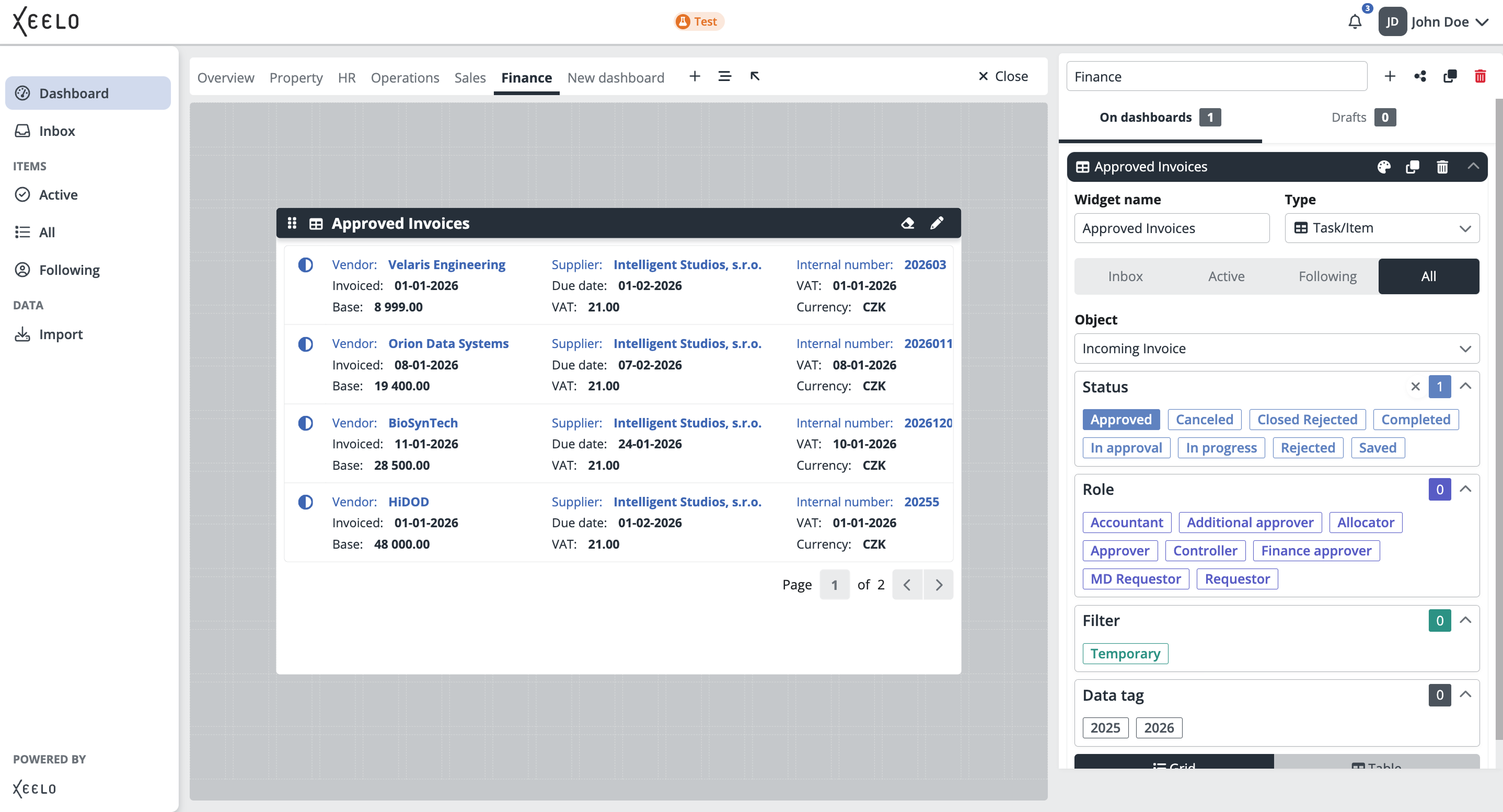
Widget configuration requires selecting:
-
View type (Inbox, Active, Following, or All).
-
Object from which the requests should be displayed.
You can then further refine filtering using the available options (role, status, tags, or a custom saved filter). The result is a request overview that exactly matches what you need to track on the dashboard.
Tip
Create your own widget focused on high priority requests or those whose processing deadline has expired.
Having a quick overview of these critical items directly on the dashboard helps you manage work more efficiently and prevent unnecessary delays.
News
The widget is used to display important updates published by the administrator. This gives users an overview of new features, process changes, or other announcements directly on their dashboard.
News content is typically managed in the administration environment. If a specific implementation is configured so that news can also be managed by a user with the appropriate permission, it is possible to create, edit, and publish news directly in the user interface.
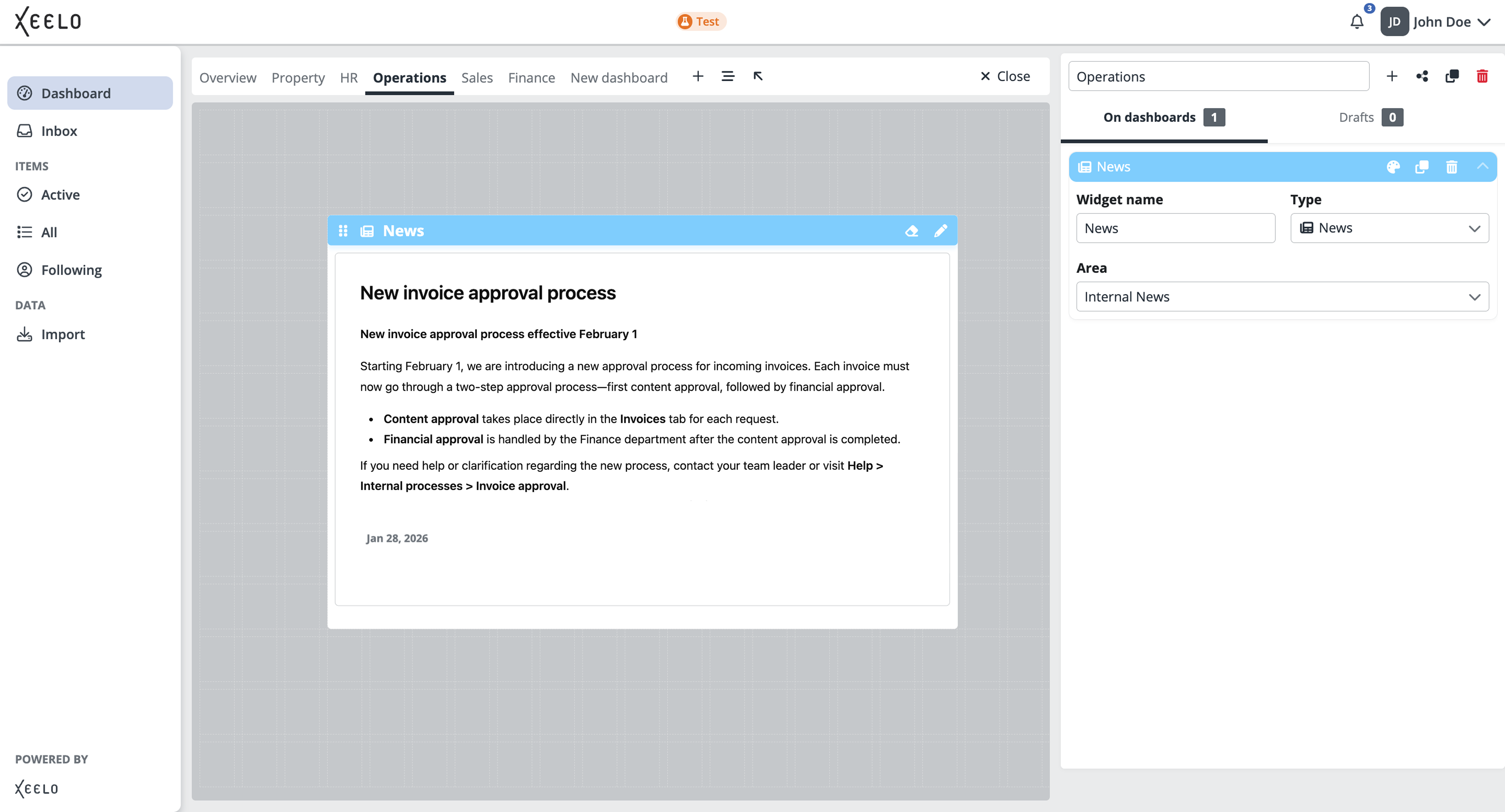
When configuring, select:
- Area from which the news should be displayed.
Tip
Use News as a central place for internal announcements. Team updates, configuration changes, or important notifications are always within reach, directly on the dashboard.
Report
The widget is used to display the output of a preconfigured report directly on the dashboard. The displayed content can vary depending on which report was prepared by the administrator—for example, a summary table, an overview of data for a specific period, or the output of a custom data analysis.
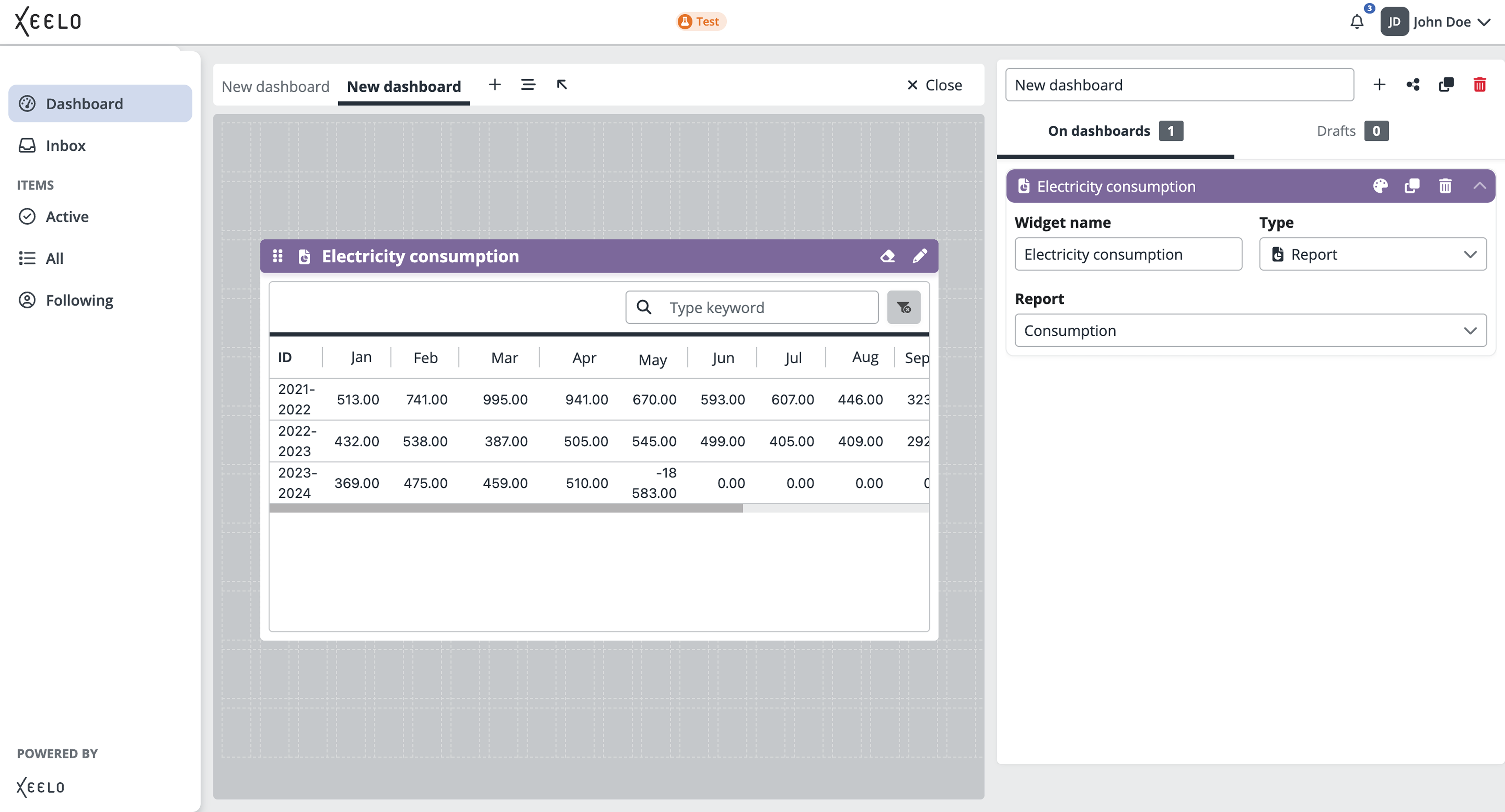
In the widget settings, select:
- Report from the list of available options. No additional configuration is required—the widget automatically loads data based on the current report state.
Tip
Do you need monthly electricity consumption, cost trends, or another regularly tracked metric in view? If the report is prepared by the administrator, you can simply add it to your dashboard.
Graph
The widget lets you visualize a selected dataset in the form of a chart, depending on how the chart was prepared by the administrator. This widget is well suited for tracking trends, comparing values, or quickly understanding how data changes over time.
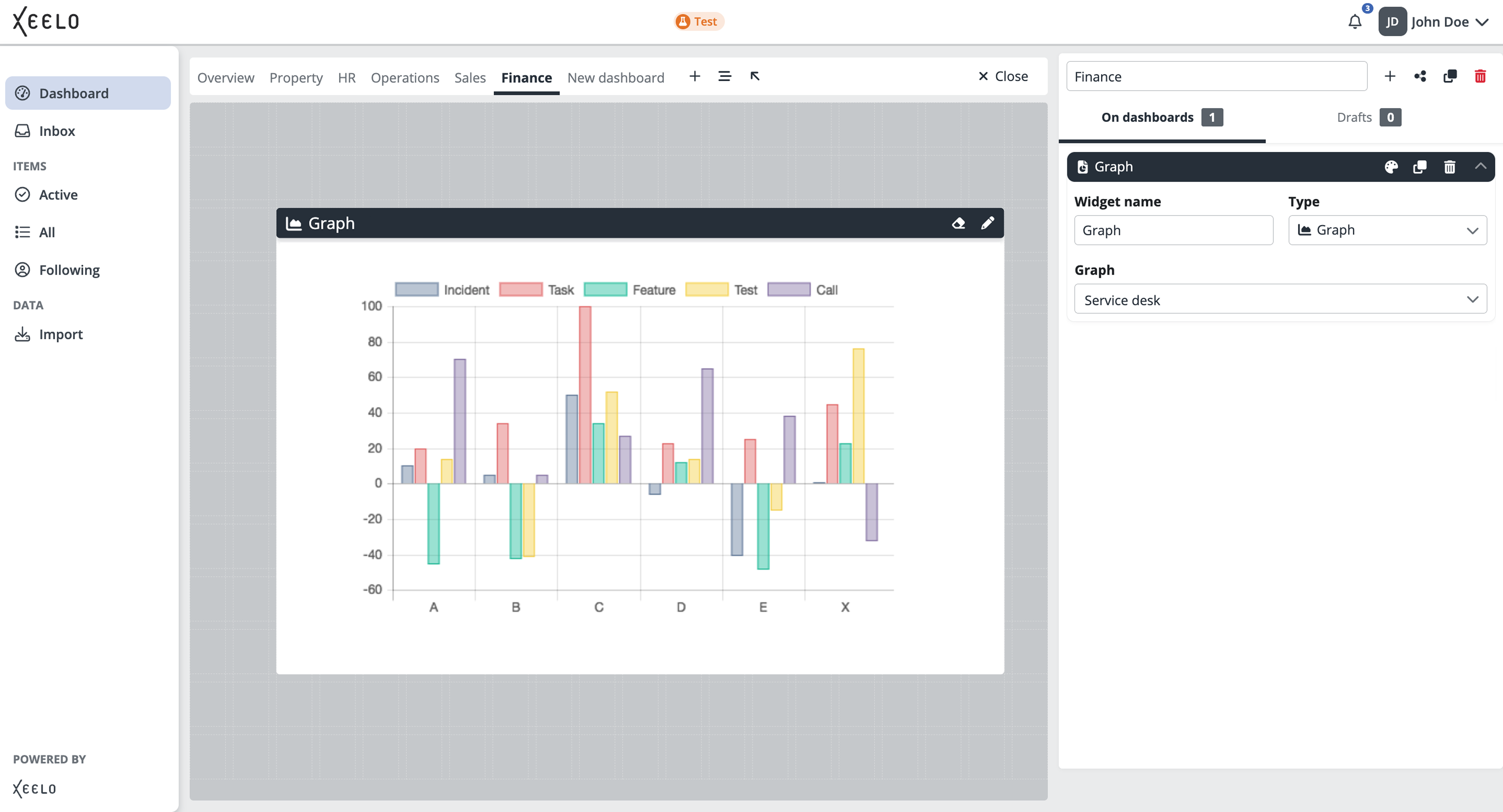
When configuring, select:
- Graph prepared by the administrator. If the field is empty, it means that no chart is currently available in the system, or your permissions do not allow you to view charts.
Tip
Track key metrics clearly and visually. With the Graph widget, you can display cost trends, the number of new requests, or comparisons across departments—at a glance.
Add new task
This widget serves as a quick shortcut for creating new requests. It allows you to start a new task for a specific object directly from the dashboard—for example, create a new invoice, submit a leave request, or request a business trip.
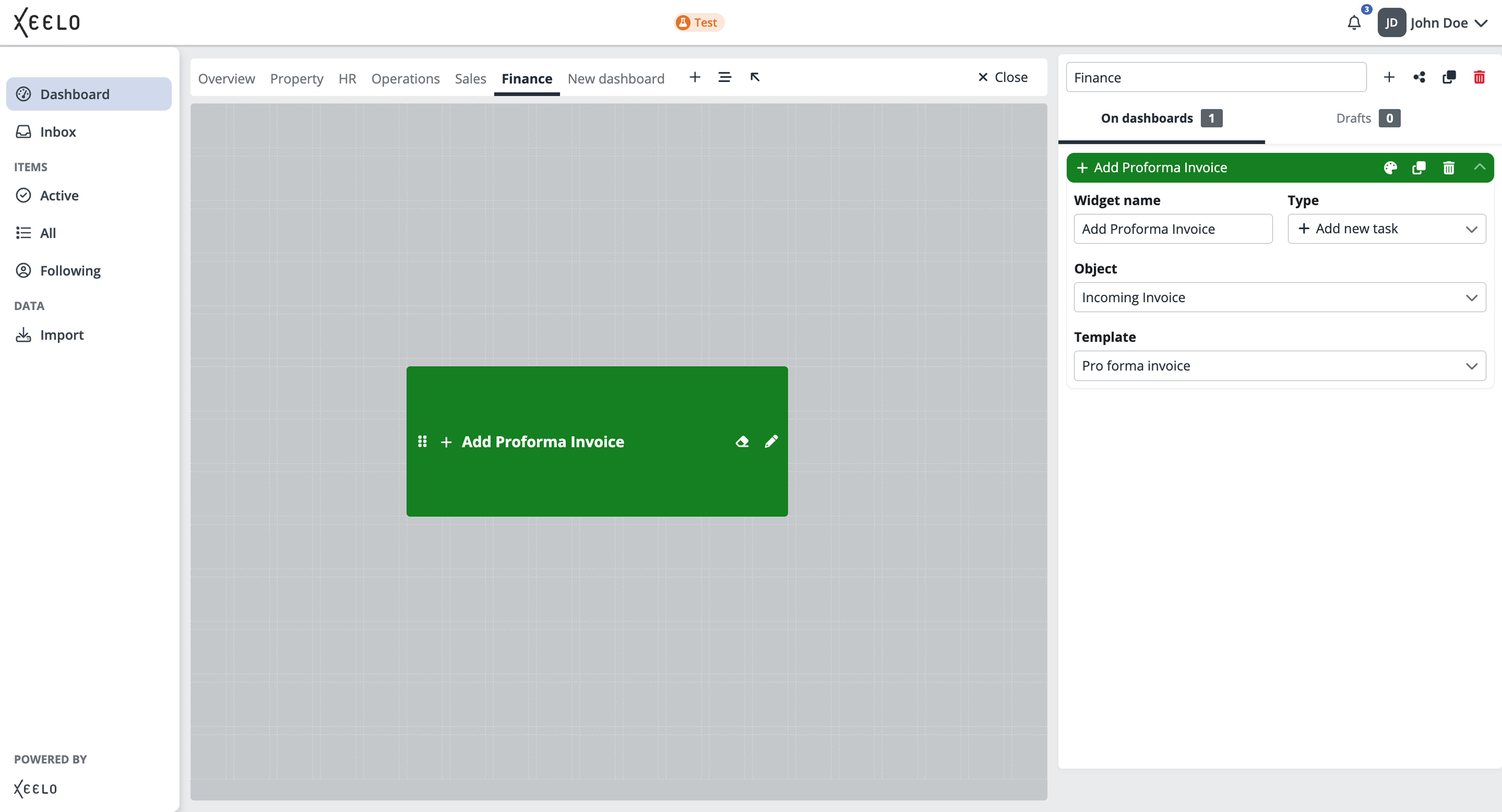
When configuring the widget, you need to select:
-
Object – the type of request you want to start with this widget (for example, Incoming Invoice, Contracts, Travel Orders, and so on).
-
Template – the specific form variant that will load automatically when you use the widget. Each template can have different required fields, preset values, or workflow. Selecting the correct template ensures that the request is created exactly as you expect.
Tip
Do you often create the same type of request? Add the Add new task widget with a preselected template. One click opens the form you need.
Item count
The widget displays a numeric value representing the number of requests that match the selected filters. It allows you to quickly see workload size or the status of a specific part of the process without opening the full overview.
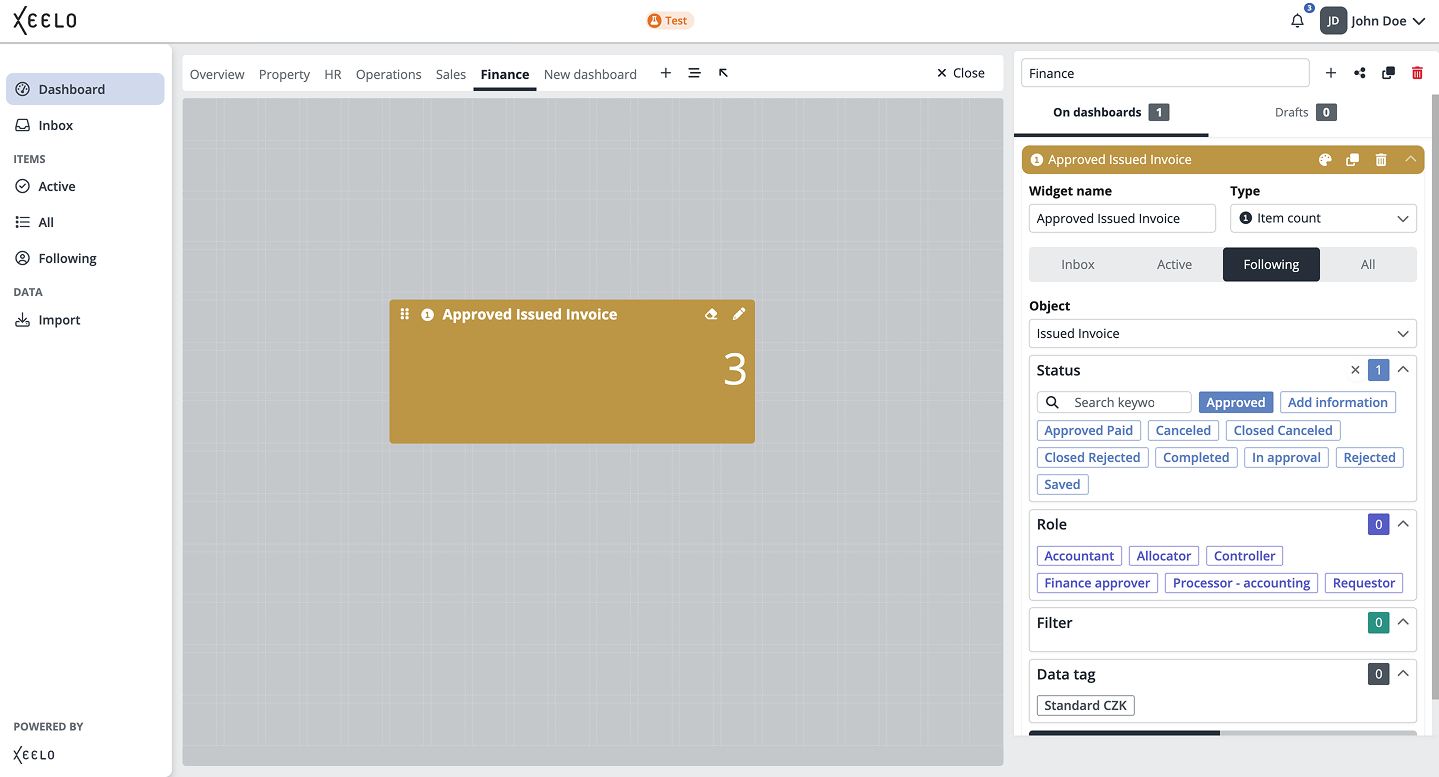
When configuring, select:
-
View (Inbox, Active, Following, or All)
-
Object (for example, Invoices or Contracts), and then you can refine the selection using additional filters—by role, status, tag, or a custom filter.
The result is a simple numeric display that updates continuously and provides a quick overview of how many requests currently match the specified conditions.
Tip
Use this widget, for example, to track the number of high priority tasks, requests in the approval process, or items waiting for additional information. It helps you plan work more effectively and respond to key changes in time.
Request detail
The widget provides quick access to a single specific request detail. It allows you to pin a specific record to the dashboard and keep it always visible. Clicking the widget opens the request in a new window.
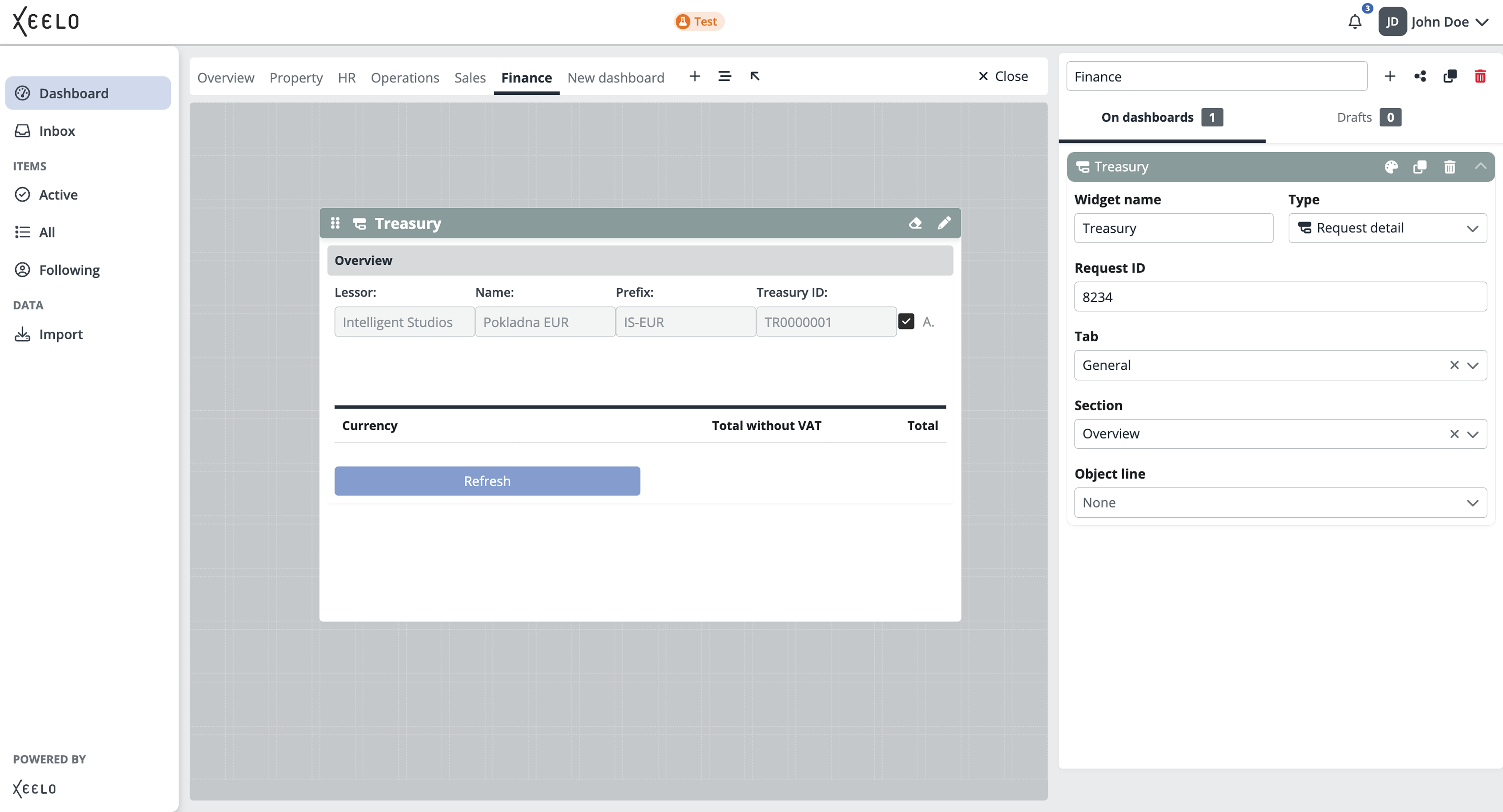
Widget settings:
-
Request ID – Enter the ID of the request you want to display on the dashboard. Without this value, the widget cannot be displayed. Information about where to find the request ID is available here.
-
Tab, Section, Object row – These options allow you to narrow the request view to only the part you need to monitor—for example, a specific approval tab, a section with financial data, or a single field with a due date.
Tip
Do you work repeatedly with one important request? Pin it to the dashboard and display exactly what you need most—such as the current status, final amount, or the approval section. No more time consuming searching—key information is always in view.
External
The widget is used to place a link to an external website or system that you want to actively work with directly from the dashboard. After you enter the link, the content is displayed directly in the widget as an interactive element—for example, you can fill in a form, sign in to another application, or view live data without leaving Xeelo.
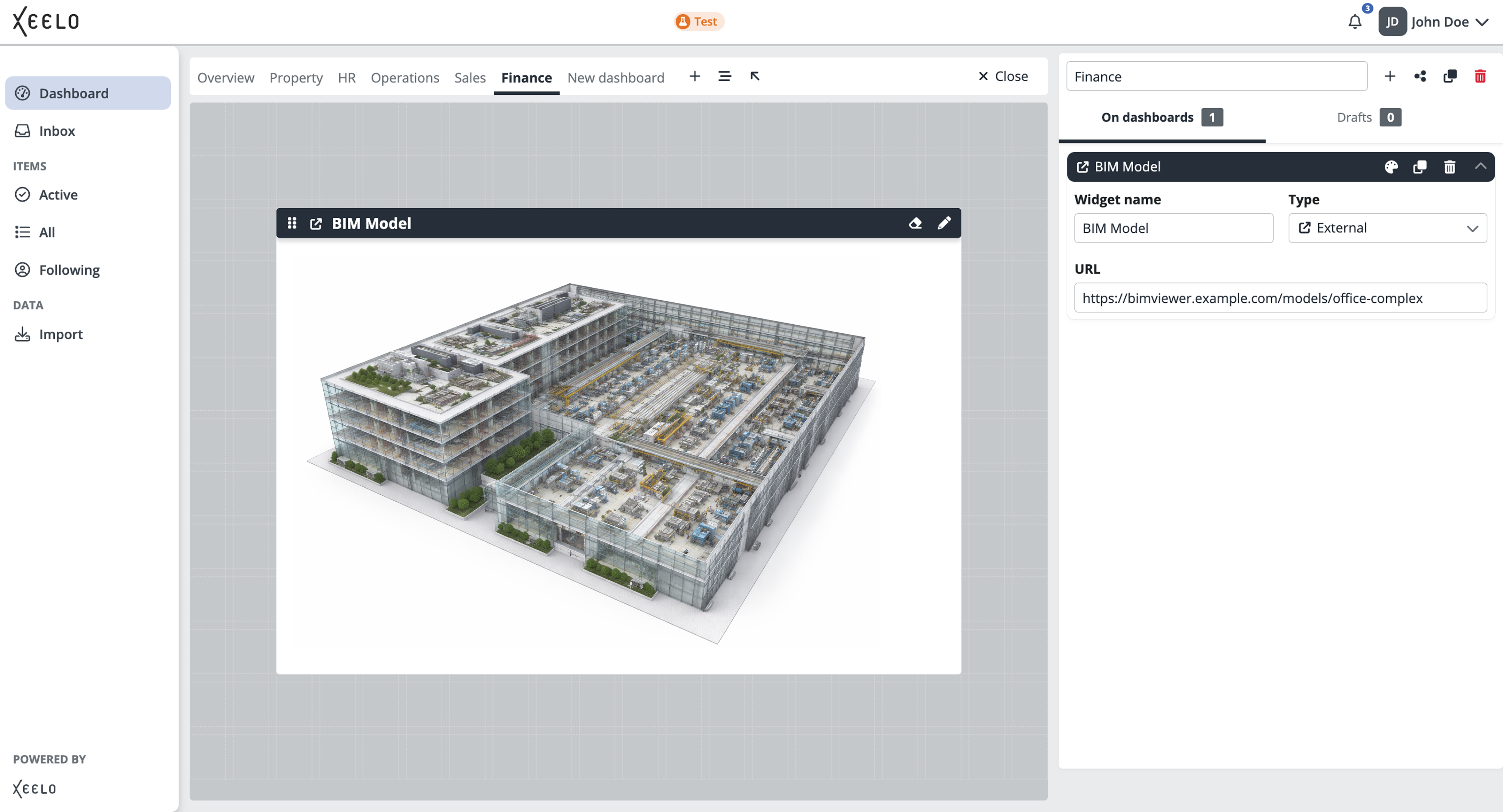
During widget configuration, enter:
- URL address, which will be displayed as an interactive element on your dashboard after it is added. For security reasons, only links to domains that have been preapproved by the administrator can be used.
External widget usage
Do you need quick access to an external application, portal, or visualization? Add a link to your dashboard—for example, an online BIM building model. The model is displayed directly in the widget and lets you interact with it without leaving the platform.
Item sum
The widget displays the total value of a selected numeric field across requests in the chosen object. It is used for a quick overview of summary data such as total invoice value, planned costs, item quantities, or other measurable values.
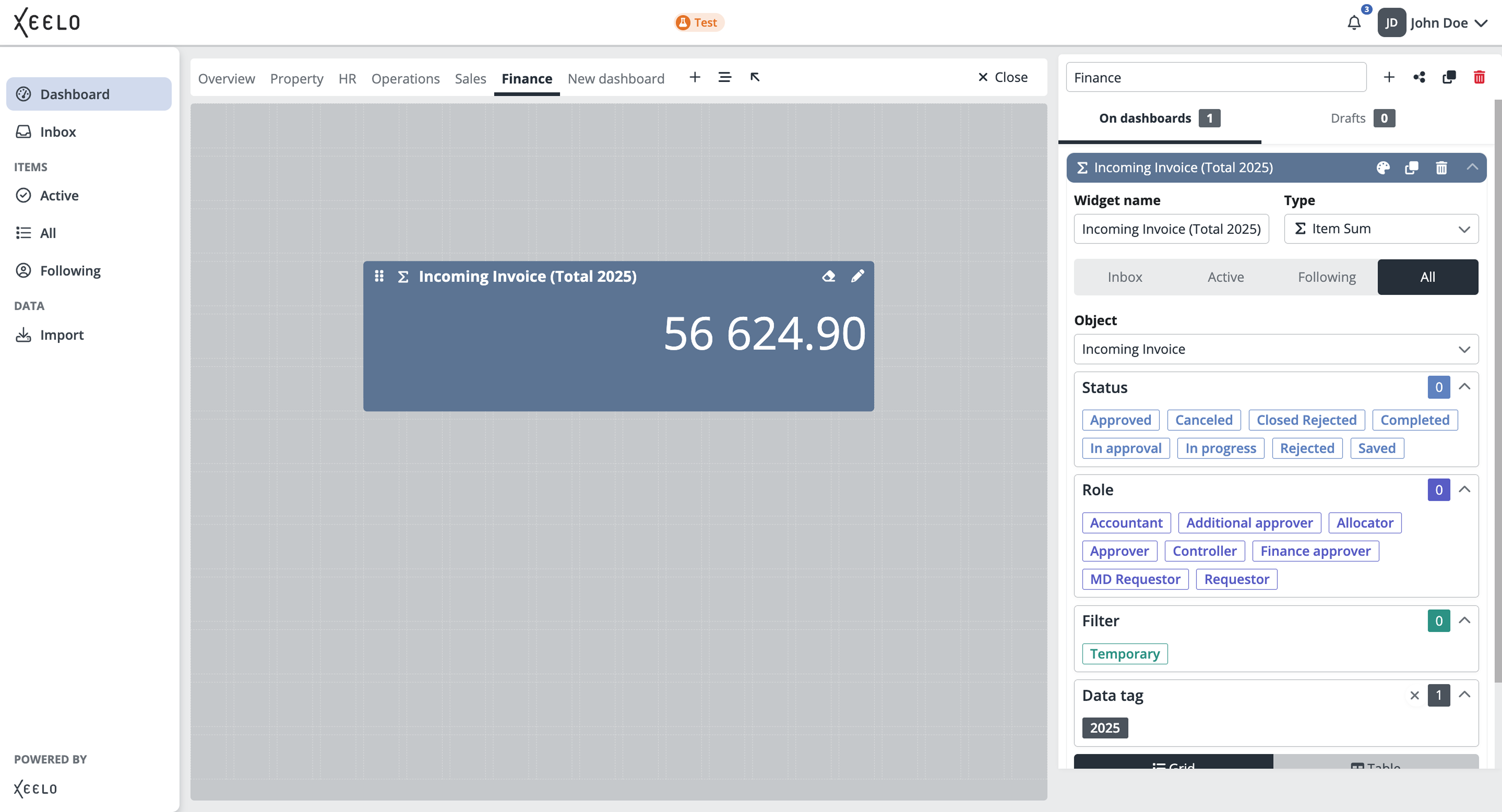
When configuring the widget, you need to:
-
Select a view type – Inbox, Active, Following, All
-
Select an object from which data should be loaded.
-
Select a numeric field whose values should be summed.
After selecting the view and object, you can further refine the result using additional filters by role, status, tags, or a previously saved custom filter.
The result is a single summary number that updates automatically based on the specified criteria and current system data.
Tip
Do you want to know the total value of issued invoices for the current period? Select the total amount field, and the widget will display the sum of those invoices on the dashboard and give you an immediate overview of business performance.
Widget management
On the right side, there is a control panel where you manage individual widgets, edit their properties, and prepare them for use on the dashboard.
In the top bar of each widget, you can find several icons:
-
Color palette icon lets you change the widget background color and text color. This allows you to visually distinguish widgets by purpose, priority, or content type.
-
Copy icon creates a duplicate widget with the same configuration. This is useful when you want a similar widget and only part of the configuration should differ.
-
Trash icon permanently deletes the widget. After deletion, the widget is removed from the work panel and cannot be restored.
-
Arrow icon for collapsing or expanding the widget lets you hide or show its configuration fields.
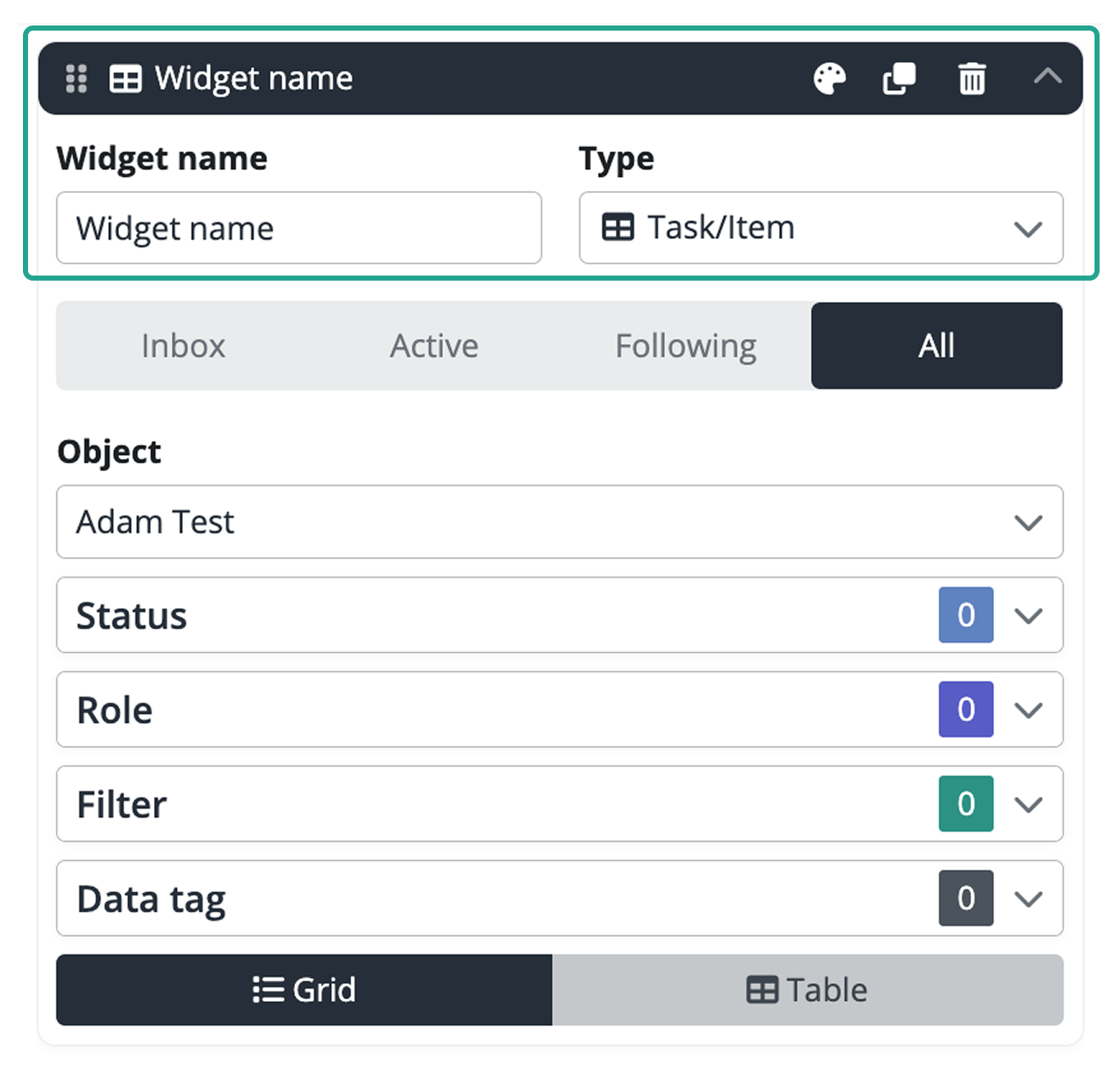
Below the top bar, there are two additional fields. Widget name is used to name the widget so it is immediately clear what it displays. This name is then also displayed directly on the dashboard. Type determines which function the widget provides from the available options.
Editing options availability
The available widget editing options may vary depending on whether you are the author of the dashboard or only subscribed to it. If you are not the author, some options may be unavailable.